
A Composer’s Journey Through Machines
Every studio tells its own story – mine just happens to involve a small mountain of computers. It turns out that I am a bit of a hoarder. It’s not really that I can’t or won’t get rid of old tech, it’s more that I always think that it’ll probably come in handy about 10 minutes after I’ve sold it or thrown it away…
As I prepare for a major new creative project rooted in the traditional music of southern Albania, I’ve been clearing space – and getting funds together – by selling off some of the machines that have helped to shape my working life.
What began as a few vintage sales on eBay has turned into a real trip down memory lane.
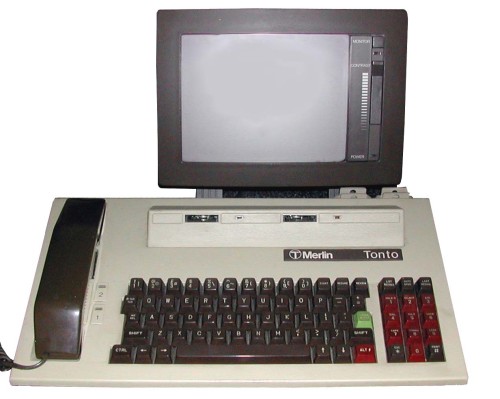
The First Steps – BT Merlin Tonto (Sinclair QL)
My first “proper” computer (well, sort of) wasn’t bought new at all. It was a retired BT-badged Merlin Tonto, a hybrid telephone/workstation built around the Sinclair QL. It came with twin microdrives using continuous magnetic tape loops that jammed at the most inconvenient moments. Somehow I wrote my undergraduate dissertation on that machine. Im not sure it ever really felt impossibly futuristic, but it was certainly something of a novelty even at the time. Fragile, temperamental, and very, very British.
I’ve no idea what became of it, but it was my first glimpse of how technology could become a creative partner, (OK, that’s probably stretching the point a bit…) I am also reminded of just how much bad language you were required to hurl in its general direction just to get it to do, err, anything much at all.
The Atari ST Era – Mini MIDI Footsteps
Next came the Atari 1040 ST, released in 1986, one of the first home computers with built-in MIDI ports. I got mine second hand in 1991. This was my first real step toward computer-based music. I ran Cubase on it – the original 1989 version – and was baffled and mesmerised by it in equal measure. I feel that I probably never really got to grips with what it was truly capable of. Looking back, it was definitely proto-DAW composition in its most primitive form and it felt different, revolutionary to write music on it.
In my twenties, while working in adult special-needs education, I experimented with early loop-based sequencing and MIDI playback. FruityLoops (now FL Studio) wouldn’t appear until 1997, but I was already doing that kind of pattern-building on the Atari: layering short loops, triggering samples, pushing the machine beyond what it was built for. I remember the Atari as a thing of joy.

From Little Acorns, Mighty Sibelius Grows
In 1997, I added another machine to my setup: an Acorn Archimedes, (possibly an A7000 if memory serves me?) built on the first ARM processors. That was purely for notation – running the very first version of Sibelius, which at that time existed only for Acorn computers.
The official release came in 1993, and it changed everything for me: suddenly, printed music could look professional without a pen and ruler or, more importantly for an absolutely skint composer, without the need for expensive copyists.
I still remember that distinctive RISC OS interface, the strange mouse buttons, and both the thrill and huge frustration at hearing Sibelius play back my first notated piece through a tiny computer speaker. It was a moment when composition began to merge with technology in a completely new way. It is ironic that these days, some 30 years even further down the track, I almost always start new compositions and new musical sketches on 18 stave manuscript paper.

The Apple Years – A Decade (or Three) of Upgrades
Fast-forward a few years and Apple became my natural home. Since the early 2000s I’ve migrated through an extraordinary range of Macs – often trading one in to fund the next wave of creative tools.
At one point I used Digital Performer alongside an Akai S1000 sampler – a rock-solid partnership for film and TV work – before returning to Logic Pro around 2006, where I’ve stayed ever since.
Over the years I’ve owned:
• Two MacBook Pros (one very recent, but both still in daily use)
• One mighty, monster Mac Pro — my main studio computer for a few years now, it cost about the same as a modern family hatchback. Ouch.
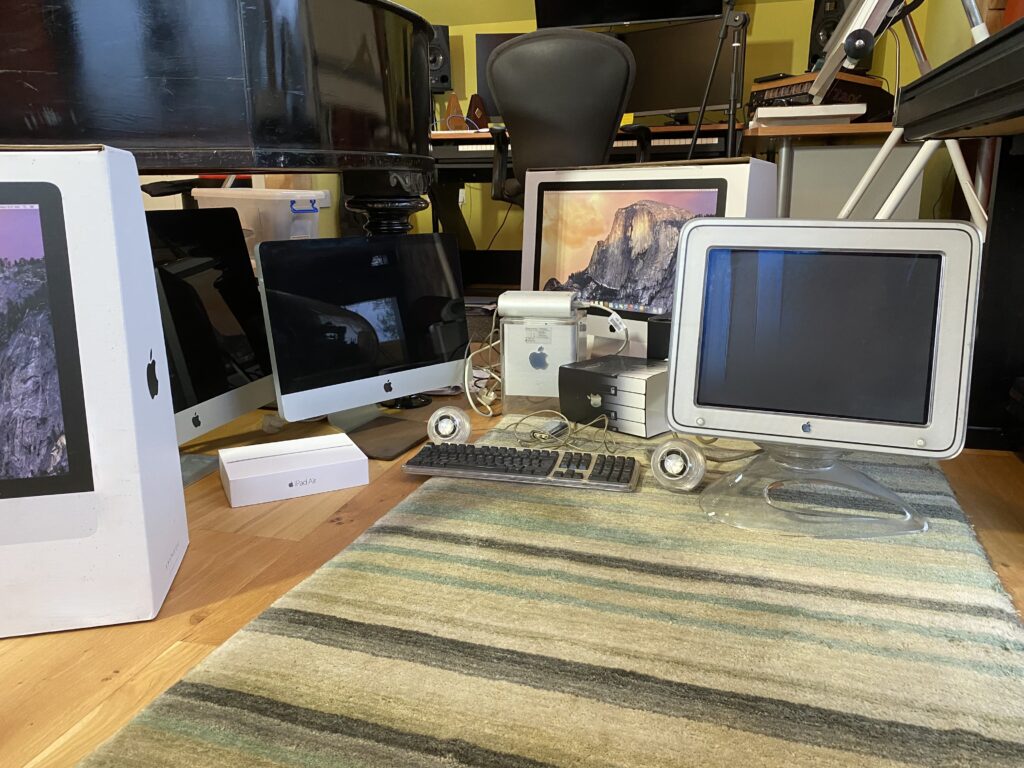
• Six iMacs, (including four that I still have – currently under my piano, spanning 2011 to 2020, from the 21.5-inch workhorse now on eBay to a 27-inch i7 Retina model still occasionally pressed into service – such a lovely screen!)
• Plus an iPad Pro, iPad Mini, two iPad Air, an iPod touch, a G4 PowerBook, and a Power Mac G4 Cube complete with its original CRT monitor and those delightfully odd spherical speakers.
When I add it all up – the upgrades, the repairs, the cables, the screens (including a thunderbolt monitor – now that was expensive…) I dread to think what I’ve spent with Apple over the years. But each machine marks a phase of my creative life: early composing, film scoring, mixing, and now field-recording and sound design.
Pocket Computers Before Smartphones – The Psion Years
Long before the iPhone, I was already obsessed with portable tech.
I still have owned at least five Psion organisers (Models II and 3, right up to the very last 5mx model) and a Palm PDA tucked away in a drawer somewhere (which I never got on with, always preferring the Psion offering).
The first Psion Organiser appeared in 1984, followed by the Organiser II in 1986 and the Series 3 in the early 1990s. They were tiny marvels – capable of calendar, contacts, and even basic programming on a screen smaller than a business card.
They didn’t make music, but they made me realise I wanted technology with me everywhere.
In meetings back in the day, everybody thought I was crazy: “What will you do if you leave it on the train?! You’ll lose everything!” Now remember, these were firmly the Filofax years still. I could legitimately come back: “If I leave my Psion on the train, I will only ever lose a maximum of one day’s worth of data. Whereas, if you leave your Filofax on the train… Oooo….!”
From There to Here – and What Comes Next
I look back fondly on those machines – the beige plastics, the hum of CRTs, the slow-loading disks. Each one carried me another step toward the music I make today.
Now I’m selling some of these pieces of history – from iMacs and iPads to the Power Mac Cube and even a Sony MiniDisc HiMD – to help fund the new equipment I’ll be using for my upcoming southern Albanian music project. It feels fitting: the past quite literally contributing to the future.
I won’t reveal too much yet, but the next chapter involves new sounds, new landscapes, and a return to the field – the intersection of traditional music, technology, and memory.
A clear desk, a clear studio, and a new creative map, perhaps…?

If you’re reading this on my website, you’ll see some photos of the actual machines I’ve owned. For the few I no longer have (the Merlin Tonto, Atari ST, and Acorn A7000), I’ve used archive images from Centre for Computing History. If you’d like to share these images, please credit the original sources or link back here.